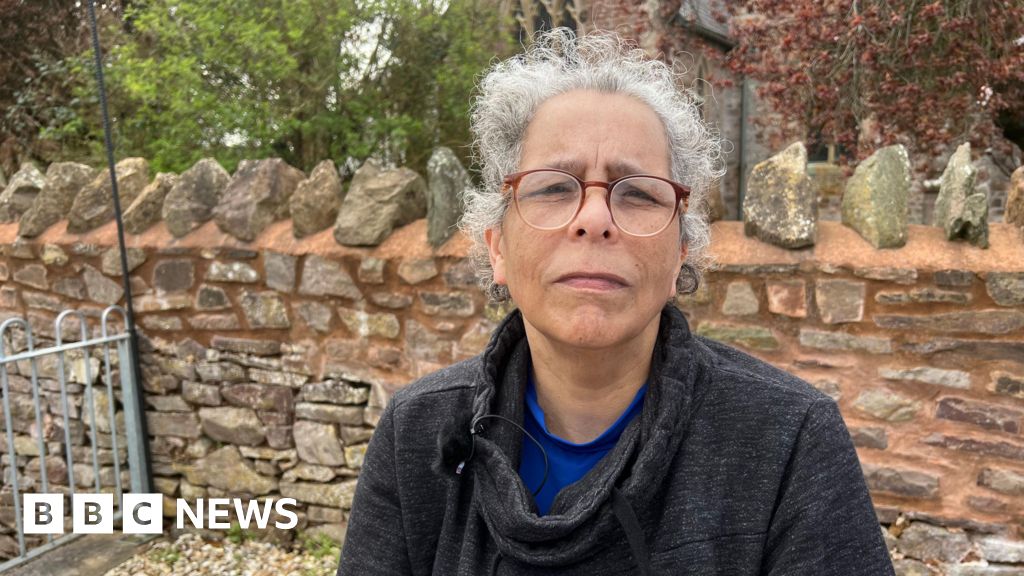

Vik Fielder's unmarried 18-year-old mother "desperately" tried to keep her baby after giving birth in 1971. But like 250,000 other British women, she was forced to give her child up for adoption. Twenty years later, she took her own life, "which was directly linked to losing her daughter".
Now, Fielder is backing fresh calls for a formal apology from the government. The 54-year-old said it would be the "first step" towards healing the trauma felt by survivors.
Following decades of calls for action, the Education Select Committee has recommended the government provides a formal apology and begins working with survivors.
Fielder said this would "go a long way towards acknowledging the fact that there was harm done".
The government said its "deepest sympathies" were with all those affected and it was "actively considering" an apology.
Fielder, a veteran who now lives on the Quantocks in Somerset, is one of an estimated 250,000 women who were affected by forced adoptions in Britain in the 1950s, 60s and 70s.
Mayor 'heartbroken' after suspension over X posts
Second air ambulance to increase lifesaving care
Airport issues travel advice ahead of busy getaway
Fielder said her mum "had no other choice" other than to give her up "and as a result of that she was dead by the time she was 38".
After reading her adoption files, she said: "It's quite heartbreaking to see the letters that go from the adoption agency to her asking her to sign her rights away knowing that she was desperately trying to find somewhere to live so she could keep me.
"I had two hits from [a genealogy website] and straight away one of them got back to me and said 'I know exactly who you are, can I phone you?'
"Then she told me that unfortunately my mother had passed away in 1992.
"She was only 38 and it was directly because of having to give me up.
"We never got a chance to meet, I never got the chance to meet my father."
She also discovered she had a sister who lived lived 40 miles (64km) from her home.
"We didn't know about each other for 50 years, that hurts because it's a relationship that I could've had with her, it's a relationship that my children could have had with their cousins which we could never get back," she added.
Fielder, who was adopted at seven days old, said it took four years for her to receive appropriate mental health treatment for issues linked to her adoption.
Being a veteran under the Armed Forces, she could have had her therapy fast-tracked, but decided it would have been "wrong because it wasn't connected to my military service".
She would like to see the same fast-tracked care given to adoptees and birth parents.
"I think an apology will go a long way towards acknowledging the fact that there was harm done," said Fielder, adding that this would make it easier for those affected to access mental health support.
The adoptee said she would also like people like her to have a marker on their medical records because having to repeat her background to medical professionals "is very, very triggering".
She said giving evidence and telling her story repeatedly had also been "exhausting".
Helen Hayes MP, chair of the committee, said: "Survivors have suffered for far too long. They simply want to move on with their lives.
"A formal apology is an essential step towards delivering the peace survivors deserve."
In the report published on Friday, the Education Select Committee recommended the government must provide an "unqualified formal apology" to all those affected by forced adoption in the UK.
The cross-party committee said ministers should provide an initial commitment to apologise, begin working with survivor groups, and commit publicly to a clear timetable for developing and issuing its apology.
Fielder said the report reflected a lot of the recommendations made by the Adult Adoptee Movement (AMM), a support group she is a member of and which has been campaigning for a formal apology from the government.
"It's the first step towards community healing, both communities, because there's a lot of guilt and shame involved in adoption and I think I can see the apology as a way of lifting that, particularly for the mothers," she said.
Hayes described hearing the evidence from survivors as "one of the most moving" days she had experienced in Parliament.
She said historical forced adoption caused "unimaginable trauma for multiple generations of women and profound, often devastating impacts for their children".
In a statement, the AMM said it welcomed the report and that an apology was "clearly overdue".
A spokesperson said: "Testimony from survivors and expert witnesses lays bare the shocking treatment experienced by both mothers and adoptees.
"The system that enabled this abuse was funded and facilitated by the state.
"We call on the government to engage with survivors to implement the report's recommendations."
A government spokesperson said the "abhorrent practice" should never have taken place.
"Our deepest sympathies are with all those affected.
"We take this issue extremely seriously and continue to engage with those affected to provide support," they added.
Additional reporting by Ross Pollard
Follow BBC Somerset on Facebook and X. Send your story ideas to us on email or via WhatsApp on 0800 313 4630.
 DW News