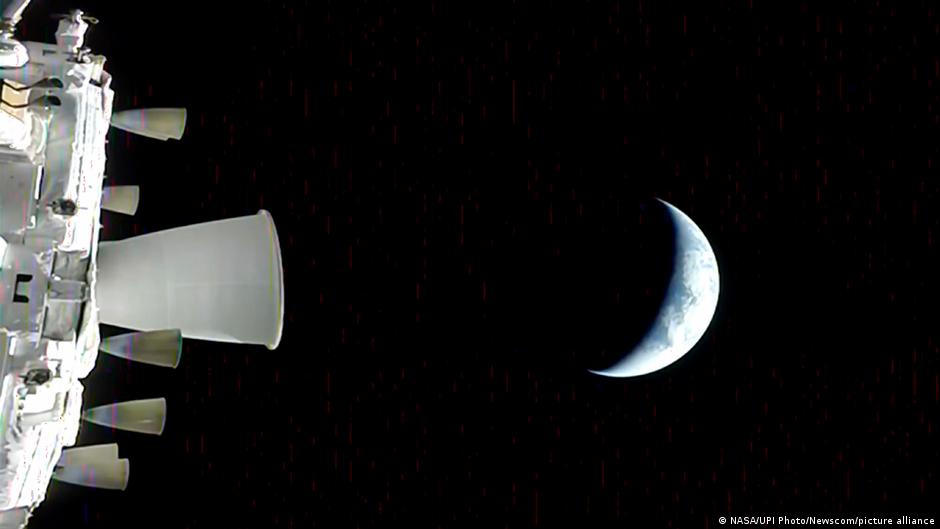

In a crucial maneuver, NASA's Artemis II astronauts fired up their spacecraft's engine, breaking away from the Earth's orbit on Thursday and blazing towards the Moon.
The key thruster firing or the translunar injection burn puts four astronauts — three Americans and a Canadian — on the path to the first crewed lunar flyby in over half-a-century since the Apollo 17 mission in 1972.
The mission control in Houston confirmed a "good burn."
The hours after Artemis II's launch
The burn was reported 25 hours after the massive orange-and-white Space Launch System (SLS) rocket carrying the Orion capsule lifted off from the Kennedy Space Center in Florida.
"We are getting just a beautiful view of the dark side of the Earth lit by the moon right now. Phenomenal," Canadian astronaut Jeremy Hansen informed mission control about 10 minutes after the thruster firing.
Hansen said that he and his crewmates were glued to the capsule's windows as they left Earth.
"Humanity has once again shown what we are capable of, and it's your hopes for the future that carry us now on this journey around the Moon," he said.
This final major thruster firing of the Artemis II now leaves the Orion capsule largely under the influence of orbital mechanics for the remainder of the historic mission.
Before Thursday's thrust, the astronauts spent their first day in space testing cameras and steering their Orion spacecraft. They also reported a minor toilet malfunction and email issues that were later fixed.
Artemis II moon flight making history
To view this video please enable JavaScript, and consider upgrading to a web browser that supports HTML5 video
Historic Artemis II program
The 10-day mission aims to reach the farthest distance humans have ever traveled in space, sending them some 252,000 miles (406,000 kilometers) and beating the record set by Apollo 13 in 1970.
The astronauts will test the Orion spacecraft, which is designed for deep space explorations, in hopes of charting the path for a Moon landing in 2028 and future missions to Mars.
It is also the inaugural crewed flight of the SLS, NASA's new lunar rocket.
The program includes several other milestones, including the first Black astronaut, the first woman and the first non-American to take part in a lunar mission.
Commander Reid Wiseman, pilot Victor Glover, Christina Koch and Hansen will zoom some 4,000 miles (6,400 kilometers) past the moon before turning back around and heading straight home without landing on the moon.