


Germany's top economic institutes say the Iran war is exposing structural weaknesses that predate the conflict — and warn that without reform, the country risks permanently underperforming its growth potential.
The Iran war is hitting the German economy at the worst possible time. Having only just fought its way out of a multi-year downturn, Europe's largest economy is now facing a new external shock — and the picture painted by leading researchers is one of structural exhaustion.
The country's top economic research institutes have more than halved their growth forecasts for 2026 in their Spring 2026 Joint Economic Forecast, published Wednesday.
The report, compiled twice a year on behalf of the Federal Ministry for Economic Affairs, draws on contributions from the German Institute for Economic Research (DIW Berlin), the Ifo Institute and the Kiel Institute for the World Economy, among others.
Iran war halves growth forecast
Where economists were still projecting growth of 1.3% to 1.4% last autumn, the institute now expects GDP to expand by just 0.6% this year and 0.9% in 2027.
Economic output effectively stalled in the first quarter, with the Bundesbank's March monthly report finding that real GDP likely stagnated on a seasonally adjusted basis in the first three months of the year.
"The energy price shock in the wake of the Iran war is hitting the recovery hard, but expansive fiscal policy is supporting the domestic economy and preventing a more severe downturn," said Timo Wollmershäuser, head of economic research at the ifo Institute.
Blocked shipping routes and disrupted energy markets are pushing up commodity and energy prices worldwide, with direct consequences for Germany's energy-intensive industry.
The price increases are feeding through to consumers. The institutes expect average annual inflation to reach 2.8% in 2026 and 2.9% in 2027.
The Bundesbank warns the rate could climb sharply towards 3% in the near term, driven primarily by higher fuel and heating oil prices.
Should the Strait of Hormuz — the central artery for global oil and LNG trade — remain blocked, upside risks to inflation could be greater still, directly weighing on private consumption that was supposed to anchor the domestic recovery.
While parts of the defence industry and civil engineering are benefiting from government spending, industry as a whole remains sluggish.
Exports are barely growing, held back by weak competitiveness, geopolitical uncertainty and trade policy headwinds.
The Bundesbank notes that low capacity utilisation is compounding the problem.
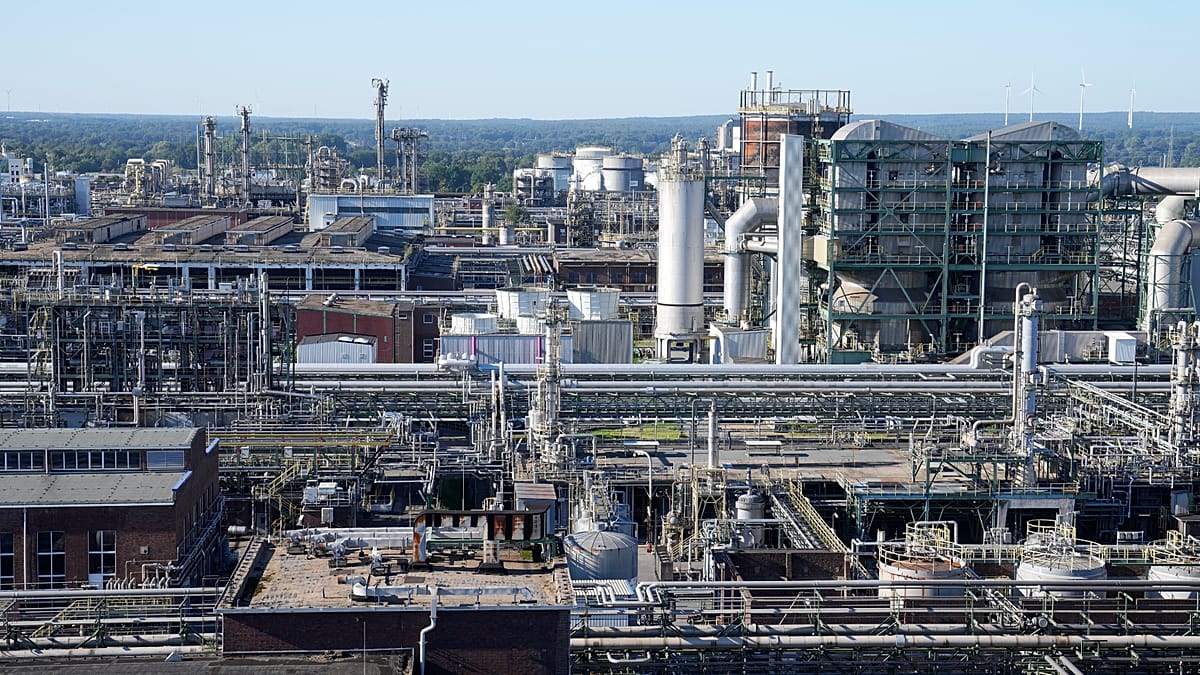
The chemical sector is bearing the sharpest pain. The Hormuz blockade is disrupting supply chains for raw materials that have no short-term substitutes.
"There will be price increases and bottlenecks because substantial chemicals will be in short supply — either from the Middle East or Asia," said Wolfgang Große Entrup, managing director of the German Chemical Industry Association.
"The situation is a particular burden for our SMEs because many of them have no chance of switching their raw material base in the short term."
Economics Minister Katherina Reiche acknowledged the sector's vulnerability.
"The industry is at the beginning of our industrial value creation and is also under particular pressure," she said.
Public debt rises to 67.2% of GDP
The German government is countering the economic headwinds with a sharp increase in public spending.
New borrowing for defence, infrastructure and climate protection will push the public deficit to 3.7% of GDP in 2026 and 4.2% in 2027, lifting gross debt to 67.2% of GDP.
The institutes see the fiscal boost as an important economic driver but warn that long-term risks to public finances are considerable, with significant consolidation likely needed towards the end of the decade.
For Reiche, the findings sharpen the case for reform.
"The message of the research institutes' spring diagnosis is clear: the conflict in the Middle East is increasing the pressure on German politicians to consistently tackle structural reforms," she said, calling for "courageous reforms".
The downturn is leaving its mark on the labour market.
Employment is expected to fall by around 100,000 this year, recovering only slightly in 2027 with a gain of around 42,000 jobs.
The unemployment rate is forecast to rise to 6.4% in 2026 before edging back to 6.2% the following year.
The medium-term outlook is gloomier still. Growth in production potential — the economy's underlying capacity to expand sustainably — currently stands at just 0.2% and could stall entirely by the end of the decade.
An ageing workforce is a key drag: as a growing share of output depends on older employees who work fewer hours on average, structural labour input is falling.
Reforms over state intervention
The institutes are unambiguous in their response to political calls for state energy price brakes: such interventions would override important market signals and prove counterproductive.
Targeted social compensation for the hardest-hit households is the preferred alternative.
What Germany needs, the institutes argue, is a consistent growth agenda — cutting regulatory barriers to private investment and innovation, and strengthening incentives to work.
The message to the federal government is stark: without structural reforms, Germany risks permanently falling short of its growth potential, regardless of how long the war in Iran lasts.
The government's own spring projection, expected shortly, is likely to also trim its growth forecast. It currently still pencils in expansion of 1.0% for this year.


 ESPN
ESPN 

 DW News