

This blog is now closed. Below is a roundup of the latest updates from across India on Tuesday, April 14:
We're closing the blog today. Thank you for reading, we'll be back tomorrow again!
Who is Bihar's new CM Samrat Choudhary
Bihar's Deputy Chief Minister Samrat Choudhary is going to succeed Chief Minister Nitish Kumar after his election as the BJP Legislature Party leader.

He will be the first BJP leader to be elevated to the CM's post in the state.
Choudhary was born into a political family. He is the son of veteran leader Shakuni Choudhary, a former army man who later joined politics in Bihar.
57-year-old Choudhary is considered one of the strongest organizational figures in the state.
Choudhary is also a key OBC (Other Backward Classes) face, representing the Koeri-Kushwaha community.
Before joining the BJP in 2017, he had been associated with multiple parties, including the Rashtriya Janata Dal and the Janata Dal (United).
Nitish Kumar steps down as Bihar chief minister
Nitish Kumar submitted his resignation to the governor, ending his tenure as the longest serving CM of the state.
Last week, Kumar took oath as a member of Rajya Sabha.
After submitting his resignation, Kumar said, "The new government will have my full cooperation and guidance. Even ahead, a great deal of good work will be done, and Bihar will advance a great deal. I extend my very best thanks to everyone and offer my best wishes."
Jaishankar speaks with Israel's Gideon Sa’ar amid Middle East tensions
External Affairs Minister S. Jaishankar had a telephone conversation with his Israeli counterpart Gideon Sa’ar on Tuesday.
In a post on X, Jaishankar said the conversation "covered different aspects of the West Asia situation."
Sa’ar said that the two leaders discussed Iran, the Strait of Hormuz, and Lebanon.
Police arrests more 350 a day after Noida protests
A day after the factory workers' protest in Noida turned violent with incidents of torching of vehicles, vandalism and stone pelting, police arrested more than 350 people.
Those arrested include 392 men and four women.
Authorities said the police is still identifying individuals involved in the protests.
WATCH — Gas crunch pushes India to dirtier cooking fuels
Indians fall back on polluting fuels amid gas crunch
To view this video please enable JavaScript, and consider upgrading to a web browser that supports HTML5 video
Many low-income families in Delhi are facing an acute shortage of liquefied petroleum gas (LPG), forcing them to cook with firewood and other polluting alternatives.
Chandni, a day laborer, says LPG cylinders are hard to find or cost around three times the usual price, making them unaffordable for households already under financial strain.
The LPG supply crisis, triggered by global disruptions linked to the conflict in the Middle East and shipping constraints through the Strait of Hormuz, has pushed homes, restaurants and small businesses back to coal, kerosene or biomass. Experts warn that this in turn threatens years of progress on clean energy, worsening air pollution and public health risks.
Bihar set to get new chief minister today
Bihar is set to witness a leadership change today, with Chief Minister Nitish Kumar stepping down after nearly two decades in power.
Kumar concluded his last state cabinet meeting today and will be meeting the governor soon.
The next Bihar chief minister will be announced today in Patna. The candidates who are most expected to become the next Bihar CM are Bharatiya Janata Party's Samrat Choudhary, Janata Dal (United) Nishant Kumar.
Government hikes minimum wages after workers protest in Noida
Following massive protests by thousands of factory workers in Noida, the Uttar Pradesh government has increased minimum wages for workers across categories.
The workers' protests over wages turned violent on Monday, prompting the government to set up a committee to address the issues of the workers and employers.
Following the protests, the government on Tuesday announced revised interim rates that will come into effect from April 1, 2026, retrospectively, officials said.
Authorities said the revision has been carried out according to the provisions of the new Labour Law codes, with an aim to ensure a more balanced and realistic wage structure amid changing economic conditions.
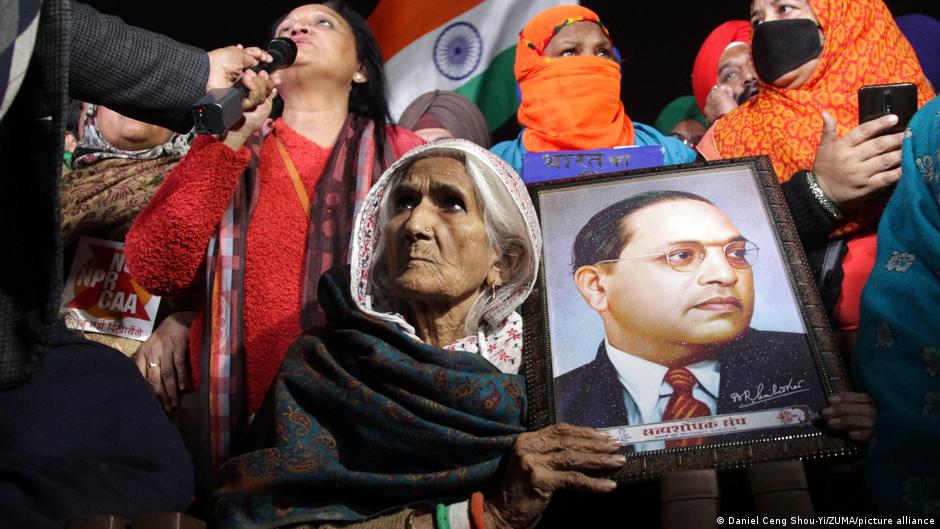
Dr. BR Ambedkar is regarded as the most prominent leader of India's Dalit community.
Ambedkar rose from poverty to study law in the UK and went on to become independent India's first minister of law and justice.
The Mumbai-born social reformer was a vocal critic of the caste system, and he led a nationwide movement advocating for Dalit rights. He played a key role in drafting the Constitution, adopted in 1950, which outlawed untouchability.
Dalits, historically referred to as "untouchables," occupy the lowest rung of the caste hierarchy and were long treated as "impure," facing widespread social exclusion.
Inequalities under the system still exist in modern India despite measures under the Constitution. Violence based on caste has been witnessed in recent times, with attacks on Dalits often driven by what is seen as their attempts to break caste barriers.
Dalit History Month in April also honors Jyotirao Phule, the 19th-century anti-caste reformer from Maharashtra who championed the eradication of untouchability and access to education for women and marginalized castes.
'Caste was always there around me every day'
The first awareness of her caste came early for Dakshita*. She was only about 12 when her classmates casually referred to her as "untouchable."
The Dalit researcher at India's prestigious Indian Institute of Technology (IIT) said, "I knew that I belonged to a Scheduled Castes then, but I didn't know what it meant."
The Dalit community in India falls under the Scheduled Castes (SC), legally recognized communities in India that have historically faced marginalization within the Hindu caste system.
Making up about 16.6% of the population according to the 2011 census, the Constitution of India allows them affirmative action, including quotas in education and employment, to promote social equality.
"Caste was always there around me every day," Dakshita said.
She recalled another incident from her childhood when her family's upper-caste landlord drew a boundary restricting them from using shared spaces, including the water taps.
"When my younger brother, who was a toddler then, crawled across that line, my family had to face rebuke," Dakshita said.
Such experiences, she says, did not disappear with education or mobility — they just changed form.
"In urban and academic spaces, discrimination is more implicit," she said, describing how conversations around merit and quotas often led to her abilities being questioned.
In one instance at a prestigious Delhi college, peers inferred her caste from her grades and distanced themselves.
While India's constitution comes down strongly on caste-based discrimination, social hierarchies continue to operate subtle ways. Dakshita pointed out that such biases often manifest through coded language, social exclusion, or assumptions about competence.
"It affects your confidence," she said, adding that discrimination today is "implicit… in a very cognitive way."
Meanwhile, at elite institutions she observed that discussions around caste discrimination, she added, are often limited or avoided altogether.
While there have been improvements compared to earlier generations, particularly in access to education and economic stability, she refrained from overstating the progress.
"I wouldn't say it has improved much… the discrimination still there," she said.
At the same time, she emphasized a growing sense of assertiveness among younger Dalits, particularly in spaces where awareness and solidarity are stronger.
This feature is a part of DW's special coverage of Dr BR Ambedkar's 135th birth anniversary.
How India's laws still struggle to dismantle caste system
DW spoke with Dr. Sumit Baudh, a professor and the executive director of the Center on Public Law and Jurisprudence at O.P. Jindal Global University in Sonipat, Haryana, to learn more about India's caste system.
Dr. Baudh belongs to the Dalit community.
DW: What is one thing Dr BR Ambedkar would be most disappointed by if he saw India today, particularly in how the law has addressed caste?
Dr. Sumit Baudh: One need not speculate about this — BR Ambedkar himself articulated his disappointment early on, most notably in his resignation as Law Minister [of India] in 1951.
That moment is instructive in at least two ways. First, his frustration with the government's inaction on what were then called the "backward classes" — a concern that would take nearly four decades to see concrete policy movement, and even then provoke intense backlash, as seen in the aftermath of the Mandal Commission implementation.
Second, his disappointment with the stalling of transformative legal reform, particularly the Parliament's failure to enact the Hindu Code Bill. These were not marginal concerns; they went to the heart of social democracy.
If we extend that arc to the present, similar patterns persist: the hesitation to undertake structural reform, the deferral of equality in the name of political expediency, and the emergence of laws — such as those regulating marriage and assumed changes in religious status (often framed as religious conversion or 'love jihad') — that would have been deeply troubling to Ambedkar. The continuity between that moment and the present is difficult to ignore.
Have regressive and problematic legal language contributed to reinforcing caste hierarchies, even within frameworks meant to dismantle them?
If I had to answer in one word, it would be: efficiency.
The constitutional language of "efficiency" appears neutral, but in practice it operates as a deeply loaded term. It is routinely invoked to question, dilute, or resist reservations and other forms of affirmative action.
What is often left unexamined is that "efficiency" is not an abstract quality — it is produced within historically unequal social and educational conditions. When law and policy treat it as neutral, they effectively naturalize those inequalities.
So here, language does not merely reflect hierarchy; it actively legitimizes and reproduces it, even within frameworks that are ostensibly designed to dismantle caste.
Which legal or policy framework meant to protect Dalits is falling short today and where exactly is the gap?
India does not have a comprehensive anti-discrimination law. Instead, what we have is a patchwork — criminal law in some cases, constitutional remedies in others, and sector-specific frameworks addressing sexual harassment, caste atrocities, and disability.
Discrimination, however, often operates in a space that is neither fully criminal nor easily addressed through constitutional litigation. It requires accessible civil remedies.
The absence of such a framework means that many forms of caste discrimination — especially in institutions like education — remain difficult to name, prove, and redress. That is the gap.
And even where frameworks exist, they are often ill-equipped to address institutional practices that reproduce inequality in less visible, but deeply consequential, ways.
This feature is a part of DW's special coverage of Dr BR Ambedkar's 135th birth anniversary.
This is Shakeel from DW's New Delhi Studio brining you our special coverage on the 135th birth anniversary of Dr BR Ambedkar, the principal architect of the Indian Constitution, who dedicated his life to campaigning against the social discrimination of the Dalit community — a historically marginalized group from the lowest level of India's centuries-old discriminatory caste hierarchy.
April is also the Dalit History Month and DW will be looking at Ambedkar's promise and anti-caste social activist Jyotirao Phule's visions of Dalit upliftment versus the reality today.
Additionally, this blog will also bring you the top news from India today. So, stay tuned for all your latest updates.