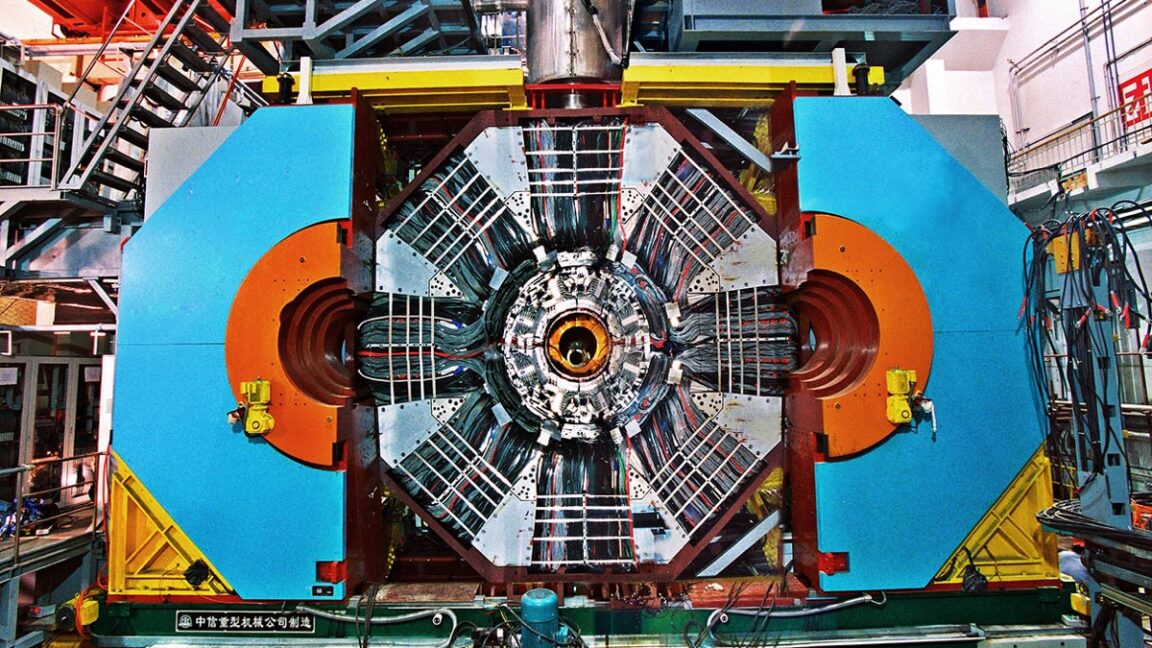

Physicists with the Beijing Spectrometer III (BES III) experiment have uncovered convincing new evidence of the existence of so-called glueballs, an elusive composite particle made entirely of gluons predicted by quantum theory. The results appeared in a preprint posted to arXiv last month and were also presented last week at the International Conference on High Energy Physics (ICHEP).
All the stuff we see around us is made up of quarks held together by gluons (carriers of the nuclear strong force) to form protons and neutrons, which comprise the core of every single atom. The Higgs boson, discovered in 2012 after decades of searching, was widely touted as the final missing piece of the Standard Model of Particle Physics. But there are still plenty of unanswered questions, including whether or not glueballs really exist. They should, if the Standard Model is correct; they're a direct prediction of quantum chromodynamics, i.e., the theory of the strong nuclear force. There should even be several kinds of glueballs.
As Matthew Francis wrote for Ars in 2015: